
The afternoon sun burned white against the glass towers of the downtown corridor, and the street hummed with the careless rhythm of a city that never looks down. Through that crowd moved an old man named Arthur Vance, eighty-three years old, blind for nineteen of them, his white cane tapping out a steady, patient rhythm on the concrete — tap, tap, tap — like a heartbeat made of sound. He knew this route by memory. He knew the crack in the third paving stone. He knew the smell of the bakery on the corner and the way the wind changed when a bus passed. What he did not know was that four young men had stopped laughing among themselves and turned their eyes on him.
The tallest of them stepped forward with the lazy confidence of someone who has never once been held accountable for anything. He extended his foot — not quickly, not violently, but deliberately, casually, the way you might kick a stone off a sidewalk. Arthur’s cane swept forward, found nothing, and the old man went down hard. The cane spun away across the pavement. His grocery bag burst open, and oranges rolled into the gutter like small, bright, useless things.
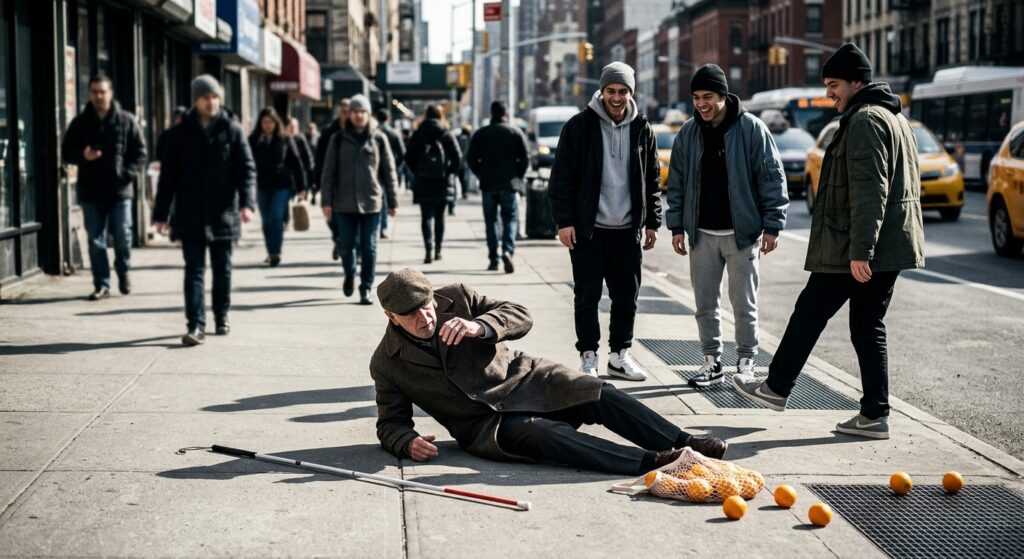
“Look at him crawl,” the young man sneered, spreading his arms to his friends as though he had just performed a magic trick for an audience. “Old man can’t even see where he’s going. Somebody get him a map.” His friends howled. One of them filmed it on his phone, thumb hovering over the record button like it was a trophy. “Go on, grandpa. Get up. Show us what you got.”
Arthur did get up. Slowly, deliberately, one hand braced against the cold iron of a parking meter, the other reaching out until his fingers closed around the familiar aluminum shaft of his cane. He straightened his coat. He adjusted his collar. And then, with a calm that was somehow more unsettling than any shout, he reached into his inner pocket and drew out a sleek black smartphone. His thumb found the button on instinct. The device chimed softly in his palm.
“Call my son,” he said, his voice low and steady, precise as a metronome. The phone answered in its smooth synthetic tone: “Calling Richard Vance.” The young man’s friends exchanged glances, but the bully only laughed harder, circling the old man like a shark. “Ohhh, he’s calling his son,” he mocked, pitching his voice into a nursery whine. “Is your son gonna come hold your hand, grandpa? Is he gonna come fight me?” Arthur didn’t answer. He simply tilted his head toward the phone and waited.

Fifty-two floors above the city, in a boardroom where a nine-figure merger was being negotiated, Richard Vance’s phone vibrated against the mahogany table. He glanced at the screen once. Then he did something no one in that room had ever seen him do. He stood up mid-sentence, cutting off the chief financial officer without a word of apology. “Gentlemen, we’re done for today,” he said, and his voice carried the flat finality of a closing door. “My father is on the line.” He stepped into the corridor, pressed the phone to his ear, and listened for exactly eleven seconds. When he lowered it, his jaw was set like poured concrete.
“Get me four vehicles at the garage ramp. Now,” he said into his second phone, already striding toward the elevator bank. “And I want them fast. Not on time. Fast.” Behind him, aides scrambled. By the time the elevator doors opened on the parking level, six men in dark suits were waiting beside four black SUVs, engines already growling, headlights cutting the dim concrete. Richard climbed into the lead vehicle and said only four words: “Corner of Ninth and Vine.”
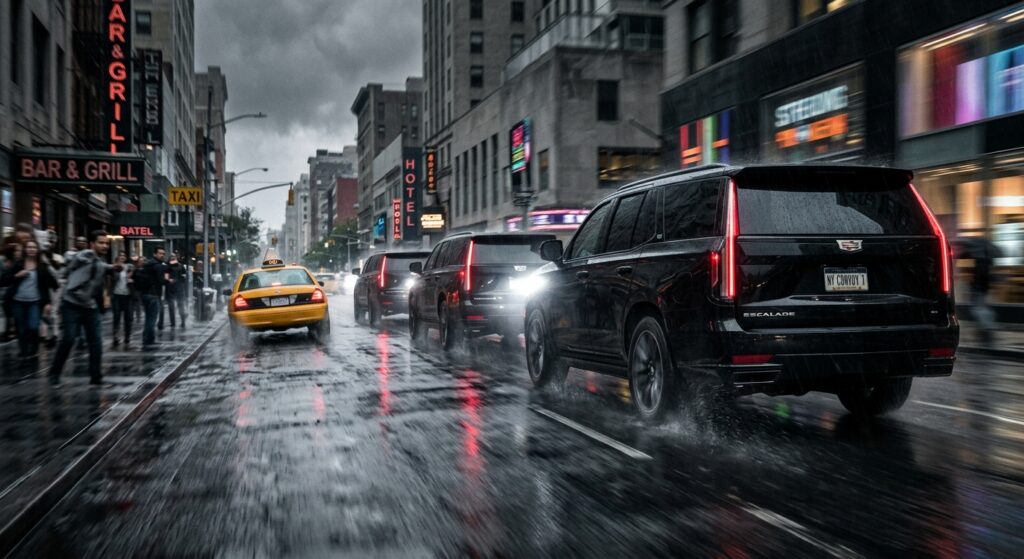
Back on Ninth Street, the bully was still performing. He danced around Arthur, jabbing a finger at the old man’s chest, playing to the small crowd that had finally begun to gather at a cautious distance. “Come on, where’s this son of yours?” he jeered. “I don’t see anybody. I don’t hear anybody. You know why? Because nobody cares about some blind old—” He stopped. His head turned. Down the avenue, past the traffic light and the line of stalled cars, a low rumble was rolling toward them — not a single engine, but a wall of them, layered and swelling, like distant thunder deciding to arrive after all.
Arthur Vance smiled for the first time that afternoon. “You asked who was coming to save me,” he said quietly, turning his sightless face toward the sound. “I told you. My son is on his way.” The rumble swelled into a roar. The first black SUV crested the rise and did not slow. Behind it came a second. A third. A fourth — a dark procession bearing down on the corner of Ninth and Vine with the unmistakable authority of something that has never once needed to ask permission.
The bully’s laughter died in his throat. His friends stepped back as one, phones lowering, hands suddenly empty and useless at their sides. The lead SUV swept to the curb and stopped with a hydraulic hiss, close enough that its massive grill loomed over the young man like a verdict. Four doors opened at once. Four men in dark suits stepped out into the sunlight. And behind them, from the back seat of the lead vehicle, a man in a tailored suit rose to his full height, looked past the frozen bully without a flicker of interest, and walked straight to his father.
“I’m here, Dad,” Richard said, placing a hand gently on his father’s shoulder. “Did they hurt you?” Arthur shook his head slowly and leaned into his son’s grip. “No,” he said. “Only my oranges.” Richard turned then, and for the first time he looked at the four young men — a long, unhurried look, the kind that catalogues a face, a name, a future. “You tripped my father,” he said. “On camera. On a public street. In front of witnesses.” He gestured vaguely toward the orange that still lay in the gutter. “Pick that up.” The bully did not move. Two of the suited men stepped forward, and suddenly he moved very fast.
The crowd watched in silence as the four of them gathered the scattered fruit with shaking hands and placed it back into the torn bag, one by one, like children completing a punishment they had not been warned about. Richard helped his father into the back of the lead SUV and closed the door gently, as though the old man were made of something precious. As the convoy pulled away, Arthur Vance leaned his head against the cool glass he could not see through, and said softly, “Thank you for coming, son.” And Richard, executive, titan, the man who had ended a nine-figure meeting without a flicker of regret, answered in a voice that belonged only to a boy: “Always, Dad. Always.”