

For ten long years, Margaret had carried the address on a worn piece of paper, a fragile tether to a son who had vanished into a world of unimaginable wealth. The journey to the city was a pilgrimage of quiet desperation, culminating at the imposing iron gates of a mansion that felt more like a fortress than a home. As the taxi pulled away, leaving her alone with her cane and her hope, she saw an elegant woman struggling with her keys by a sleek car. “Excuse me, madam,” Margaret began, her voice weathered but clear. “I’m looking for my son’s house. His name is Michael.”
The woman—Amelia, Michael’s wife—turned, her eyes sweeping over Margaret’s simple, threadbare coat and worn shoes. “Michael is my husband. Are you really his mother?” The disbelief was palpable. Margaret leaned heavier on her cane, a knowing smile touching her lips. “Judging by the way you’re looking at me, you probably think I’m too old to have ever had children, don’t you?” Amelia’s composure broke into a surprised laugh. “No, mother-in-law, please forgive me. It’s Michael’s fault. Every time I wanted to visit my relatives, he always said he didn’t have time.” She opened the gate, ushering Margaret into a world of marble and crystal.
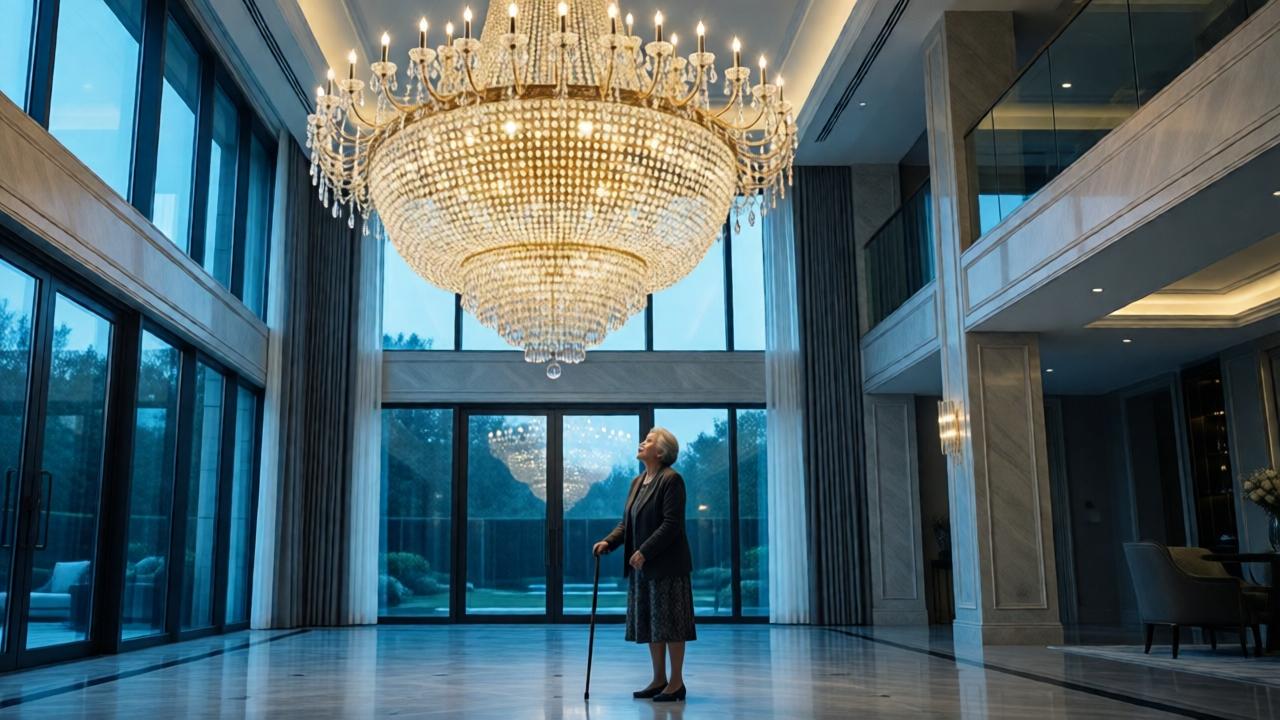
Inside, Margaret’s quiet observation cut through the opulence. “This place is awfully gaudy.” Amelia, now plagued by a burning question—why did her billionaire husband’s mother look like she hadn’t had a decent meal in years?—showed her to a guest room. After a shower and a change into clean linens, Margaret came downstairs. At the dining table, she ate with a focused, rapid intensity that spoke of deep hunger, both physical and emotional. Amelia watched from behind, arms crossed, tears welling as she saw the 85-year-old woman devour the food. She didn’t dare speak, sensing a story far bigger than the silence in the room.
The front door swung open with force. Michael entered, a portrait of power in a sharp suit, a phone glued to his ear. He marched through the living room, his gaze only lifting when he reached the dining area. He saw a stranger at his table. Pointing past her to his wife, his voice was a blade of ice. “Who is this woman? Why is she in my house eating my food?” Amelia’s reply was a whisper meant to calm a storm. “Honey, lower your voice. This is your mother.”
[Image upload failed: A tense, close-up scene at a luxurious modern dining table. A furious billionaire in an expensive suit stands frozen, pointing accusingly at an elderly woman who has just looked up from her plate. His wife stands between them, one hand slightly raised in a placating gesture. The mood is one of shocking confrontation. Lighting is harsh from a single overhead source, creating deep shadows on their faces. The composition is tight, focusing on the raw emotions: his rage, her calm defiance, and the wife’s distress. Style is hyper-realistic, capturing every detail of expression.]
The air crystallized. Michael stopped dead. For a heartbeat, Margaret met his eyes—a decade of absence hanging between them. But then he turned his fury on Amelia. “Who gave you the right to seat my mother at my $50,000 dining table? Who gave you that right?” he seethed, his words dripping with contempt. “She doesn’t deserve this.” Margaret slowly set down her fork. The truth, long buried, was now at the table with them. “You’re right, Michael,” she said, her voice suddenly strong. “I didn’t deserve to be abandoned. But you don’t deserve the lie you’ve built your life on.”
Amelia looked between them, utterly confused. “What lie?” Margaret’s gaze never left her son. “The fortune you’re so proud of, Michael. It wasn’t from some brilliant startup. It was from the sale of our family home—*my* home—the one I signed over to you to pay for what you called ‘business school.’ You told me you lost it all in a bad investment. You let me believe I had nothing, while you built… this.” She gestured around the room. “I lived in a rented room, surviving on a pension, thinking my son was struggling too. For ten years, I was too ashamed of my poverty to reach out, fearing I’d be a burden. You knew that.”

Michael’s defiance evaporated, replaced by a pallor that made him look suddenly small. The gaudy chandelier, the $50,000 table—they were monuments not to success, but to betrayal. Amelia’s tears finally fell, not just of pity for Margaret, but of horror at the man she married. Margaret pushed her plate away, her hunger gone. “I didn’t come for your money, Michael. I came because a mother should know if her child is alive. Now I see he is, but the boy I raised is not.” She stood, the weight of the truth making her cane seem less a support and more a symbol of what she had endured. The confrontation was over. The reckoning, for all of them, had just begun.