

The air in the crowded train car was thick with the heat of too many bodies and the low hum of indifference. Among the standing passengers was Mara, a woman in her third trimester, her hand white-knuckled on a metal pole as the train lurched. A teenage boy, slouched in a seat nearby, kept extending his legs, his foot nudging her shin, making her grip precarious. His mother sat beside him, scrolling through her phone, a silent spectator to her son’s subtle blockade.
Mara took a steadying breath. “Excuse me,” she said, her voice gentle but clear over the rumble of the tracks. “Could you please ask him to move his legs so I can hold on properly?” The mother looked up, her expression shifting from boredom to annoyance. She scoffed, a short, dismissive sound. “He’s just being a kid. Stretching his legs. Stop being so dramatic.” The boy smirked, emboldened, and moments later, he deliberately shoved his bulky backpack into Mara’s stomach. The act was a violent punctuation in the tense silence.

That was the final straw. Mara signaled for the conductor, who arrived with a weary sigh. Instead of listening to her account, he cut the discussion short. “To avoid any more drama,” he stated flatly, “I’m going to have to ask you both to step off at the next stop and sort it out.” The mother’s smirk returned, triumphant. “See?” she said to Mara as they disembarked onto the platform. “Learn to mind your own business.” She grabbed her son’s arm and strode away, leaving Mara standing alone, taking deep, calming breaths. The injustice burned, but she filed the moment away, a lesson in human character.
Later that same afternoon, the woman from the train, whose name was Linda, walked into the sleek glass atrium of Veridian Tech, confidence radiating from her tailored suit. This job interview was her ticket out of a string of temporary positions. “They’re looking for someone with initiative and people skills,” she rehearsed in her head, pushing the morning’s unpleasantness aside. She was led to a conference room with a stunning city view. As the door opened, her practiced smile was bright and ready.

It vanished in an instant. Seated at the head of the imposing table was Mara. Not the tired commuter, but a poised executive, her demeanor calm and utterly in charge. The nameplate in front of her read ‘Mara Thorne, Director of Human Development.’ Linda’s blood ran cold. Her portfolio felt suddenly heavy in her hands. “You?” The word escaped her lips, barely a whisper. Mara looked up, meeting her gaze with a serene, unreadable expression. “Yes,” she replied softly, gesturing to the chair opposite her. “Please, have a seat.”
The interview was a formality that lasted less than five minutes. Mara asked no technical questions. Instead, she simply said, “This role requires leading a team. It demands empathy, respect, and the ability to model those qualities in all situations, public or private. Can you speak to your experience in that area?” Linda’s mind went blank, the memory of her own words—”He’s just being a kid”—echoing cruelly in the silent room. She stumbled through a generic answer about customer service, but the verdict was already clear in Mara’s eyes. “Thank you for your time, Linda. We’ll be in touch,” Mara said, her tone final. There would be no call.
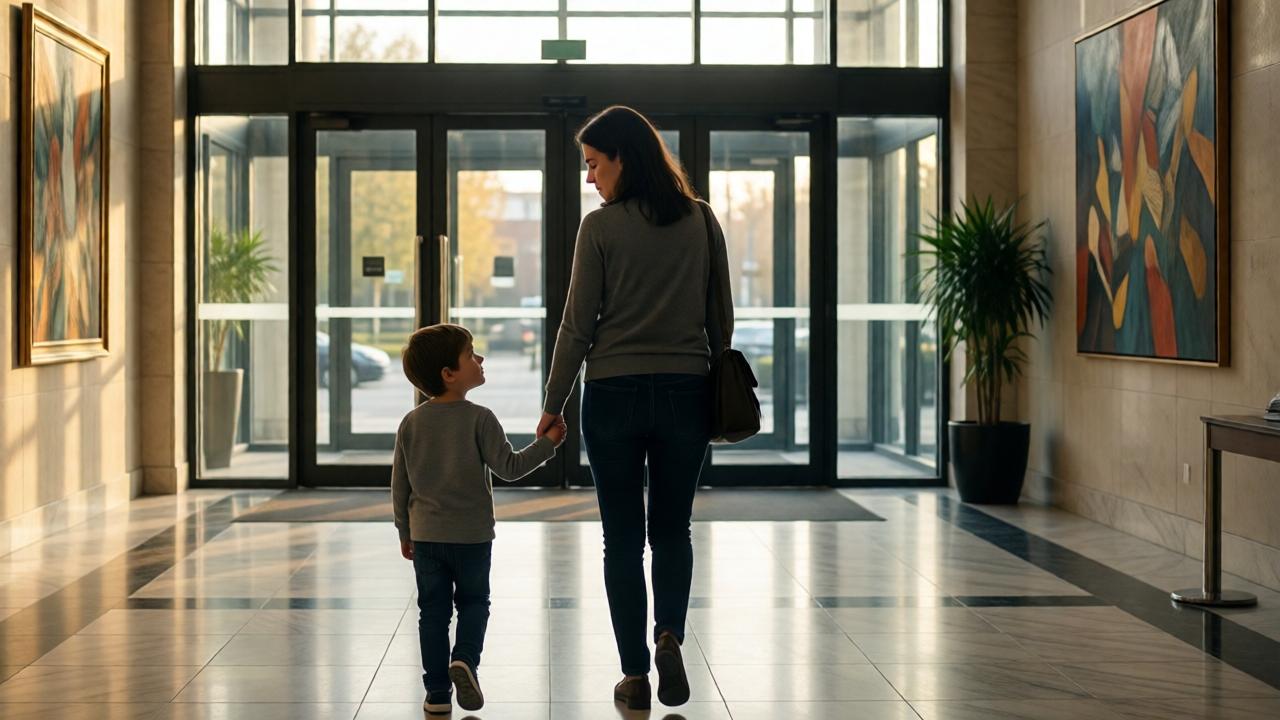
In the echoing lobby, Linda found her son waiting in the childcare area. She took his hand, her earlier pride replaced by a hollow shame. As they walked through the automatic doors into the fading daylight, she finally understood the cost of her morning’s choices. She knelt down, bringing herself to his eye level. His face, usually so defiant, looked small and uncertain. “Listen to me,” she whispered, her voice thick with an emotion he rarely heard. “What happened today… that was my fault. Next time, we treat people better. Okay? No matter who they are or where we see them.” It was a lesson learned too late for the job, but perhaps, just in time for everything else.