In the vast hall of the international chess tournament, there was that special, almost sacred silence known only to true chess tournaments. Two hundred boards, two hundred concentrated faces – and somewhere in the back corner stood Lena Seidler, twenty-eight years old, in a gray cleaning lady’s uniform. For six years, she had been mopping the floors after the tournament ended, collecting empty cups, and thinking every evening with bitter relief: “Another day gone. And good so.” The pieces on the boards were for her silent ghosts of a past she had buried twelve years ago when her father, the German chess master Otto Seidler, died on his way home from a tournament.
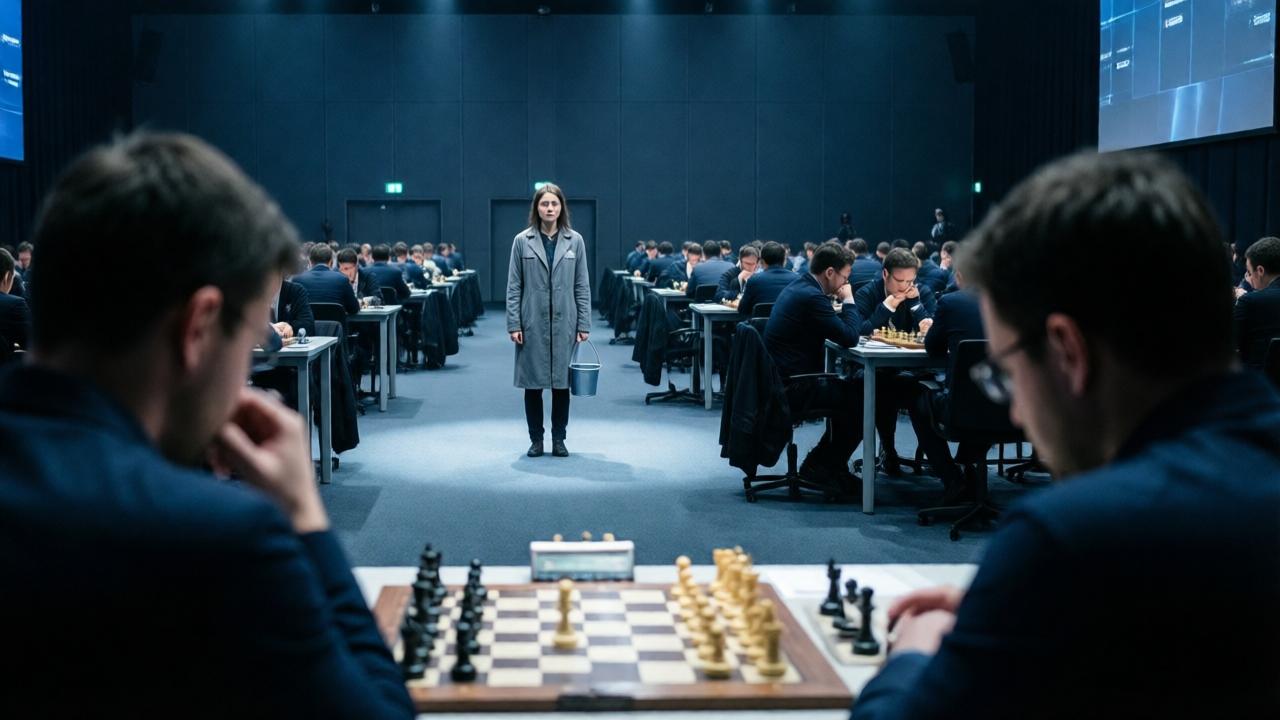
The memory still burned: “A queen without a knight is not a queen. Tomorrow we will finish playing,” her father had said when he gifted her the small, hand-carved white knight made of cherry wood. It was the evening before his death. Since then, Lena had not touched a piece, as if the chessboard were an open grave. But on the last day of the big super tournament, the unimaginable happened. The young grandmaster Felix Kranz had finished his game, and the position remained for analysis. As Lena mopped under the table, her gaze fell on the board – and she saw it immediately. A fatal mistake. “If Black moved the knight to f3, the game was lost,” she instinctively recognized. Without thinking, almost as if in a dream, she placed the white bishop on the correct square.
“Hey! What are you doing?!” The cutting voice of Felix Kranz tore through the sacred silence. Cameras swung in, all eyes turned to the woman in the cleaning uniform. “You touch my board with dirty hands?” Kranz mocked, his smile a mix of outrage and condescension. “Maybe you’ll play against me next, cleaning lady?” Nervous laughter rippled through the hall. Lena lowered her head, her cheeks burning. “Sorry…” But Kranz, fueled by the audience’s mockery, saw his chance for a spectacular humiliation. He grinned at the organizers: “Let’s make a show out of it. Blitz game. Five minutes. Me against Cinderella.”
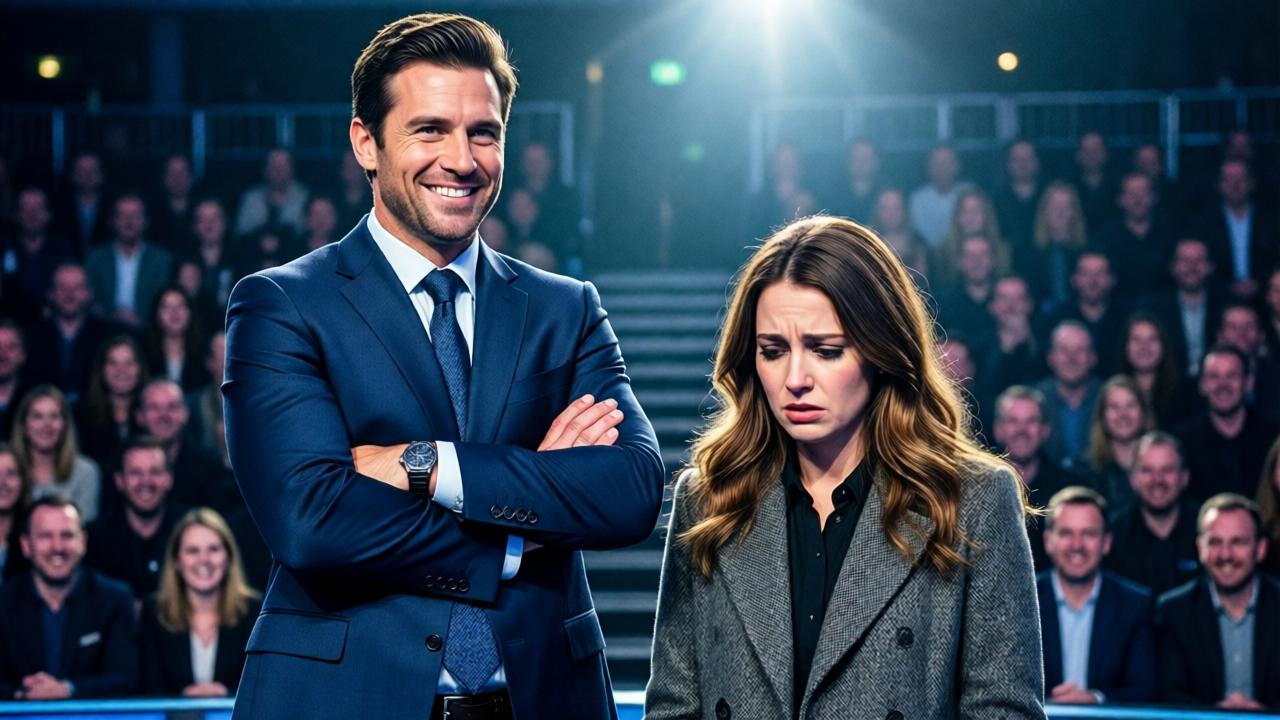
Lena wanted to run away, to dissolve into nothing. But inside her, clear and distinct, she heard her father’s warm, calm voice: “Don’t be afraid to lose. Be afraid of never having tried.” A spark ignited in her chest. “I agree,” she said softly, almost inaudibly. They placed her on the stage. She took off her gray uniform, underneath she wore a simple black T-shirt. As the clocks started and Kranz made the first move with white, the giggles in the hall were still loud. But move by move, it fell silent. Lena did not play. She remembered. Every move was a conversation with her father, every movement of her knight a recognition. Her hands, which had only carried buckets for years, guided the pieces with an innate precision.
In the fourth minute, under the pressure of the ticking clock and the unexpected resilience of his opponent, Felix Kranz made a fatal mistake. Lena saw it immediately. She took a deep breath, moved her bishop – a quiet, unremarkable move. Checkmate. For three seconds, there was absolute silence, as if the world held its breath. Then the hall erupted into applause that made the windows tremble. Kranz stared pale, as if turned to stone, at the board. Slowly, with a sudden humility, he extended his hand to Lena. “Who are you?” he whispered, his former mockery replaced by breathless awe.
The moderator held a microphone out to her. “How can you play like that?” Lena’s gaze sought support in the crowd but found only the memory. “I haven’t played for twelve years,” she began, her voice trembling. “The last time with my dad. He was a master.” She took a deep breath. “He always said: ‘Chess is not about winning. It’s about not giving up, even when the whole world is against you.'” Tears came now uncontrollably. “He died on his way home to me. Since then, I couldn’t look at a board anymore. I was afraid I would accept that he was no longer there.” She pulled the small, worn white knight from her pocket. “Today I sat down. For him.” She gently placed the tiny wooden figure next to the fallen black king on the board. “Papa… I didn’t give up.”
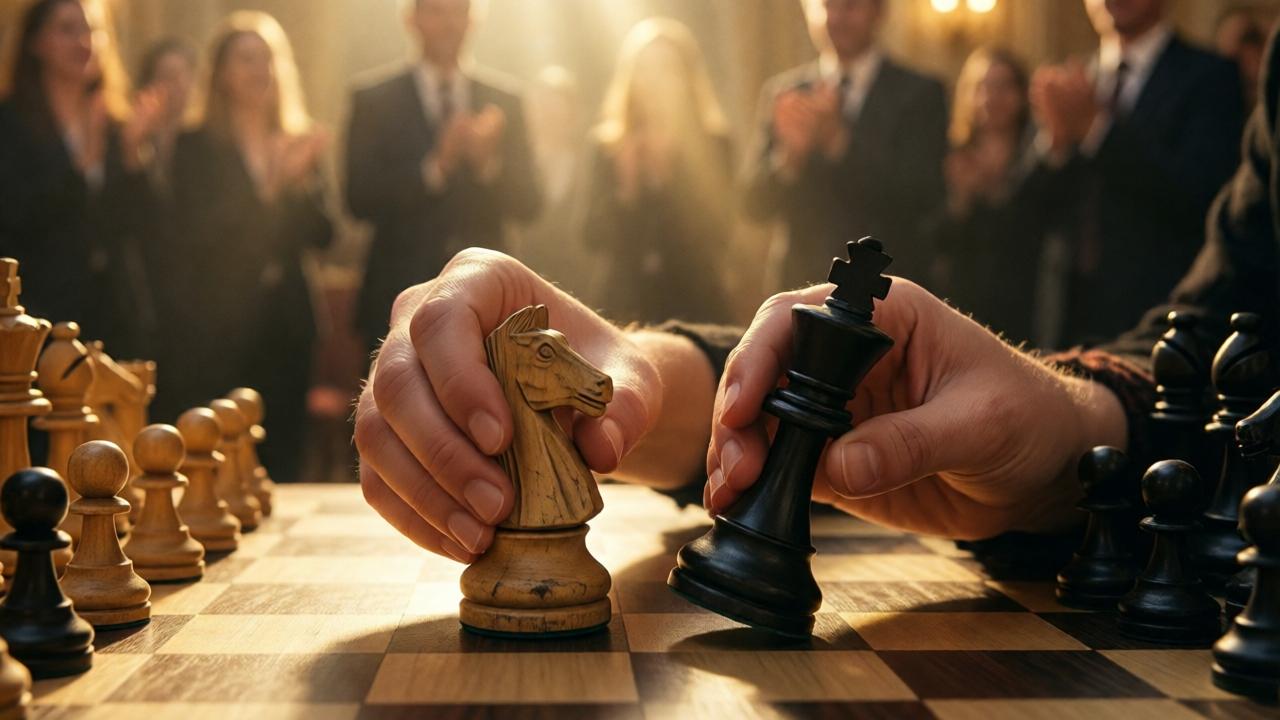
The hall fell silent, touched by a truth that went deeper than any sporting triumph. Then people began to clap, one after another, until everyone was standing. Even Felix Kranz wiped his eyes with his sleeve and said, barely audible to himself: “I lost to a legend.” Lena accepted neither prize money nor lucrative offers. She quietly put her gray uniform back on, took her bucket, and left the hall through the staff exit. Outside, on the cold steps, she sat down, pressed the white knight to her chest, and whispered into the evening wind: “We won, Papa.” The wind brushed through her hair – and for a moment, it felt like the warm hand of her father. For the first time in twelve years, the emptiness was no longer painful but filled with a peaceful certainty. He had only been waiting for her to make the most important move of her life: the return to life.