
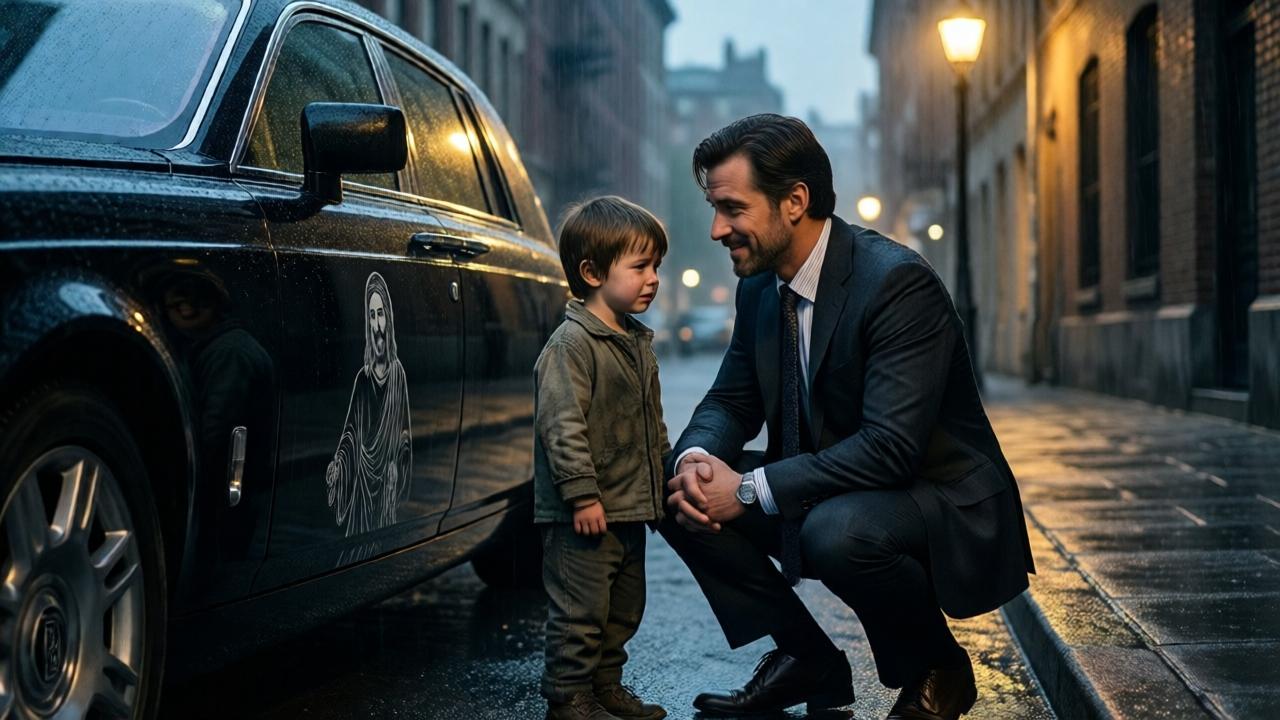
The air, thick with tension just moments before, seemed to still. The boy, his cheeks still wet, looked up at the man kneeling before him. The word hung in the silence, a fragile, precious offering. “Dad?” the boy whispered, his voice barely audible. The man—the boss—simply nodded, his own eyes glistening. “Yes,” he said softly. “If you’ll have me.” In that quiet alley, against the backdrop of a luxury car now adorned with a child’s hopeful drawing, a new chapter began, not with a legal threat, but with a promise.
The chauffeur, who had been so quick to anger, stood frozen, the boss’s earlier words echoing in his mind: “Don’t forget your roots.” He watched as his employer gently led the boy, whose name they learned was Leo, to the passenger seat of the Rolls-Royce. “We’re going home, Leo,” the boss said. The chauffeur, whose name was Marcus, finally found his voice. “Sir, I… I am so sorry. To both of you.” The boss paused, looking at Marcus not with anger, but with understanding. “Get in, Marcus,” he said. “We have a lot to talk about.”
The drive to the penthouse was silent but not uncomfortable. Leo stared out the window, clutching his pencil. The boss, whose name was Arthur, broke the silence. “My father was an artist,” he began, his gaze distant. “He died when I was not much older than you. I had to fight for everything after that. This car, this life… it was my way of proving I survived. But seeing your drawing, Leo, it reminded me of what he taught me: that real value isn’t in what you own, but in what you create—and who you lift up.”
Over the following weeks, a new routine emerged. Leo had a room filled with art supplies, and Arthur would often sit with him after work. Marcus, carrying his shame, threw himself into being their protector and, slowly, a friend. One afternoon, as Leo sketched at the kitchen island, Marcus hesitantly approached. “I was in foster care,” he admitted quietly. “I was so angry at the world. I thought being tough, guarding expensive things, was strength. I was wrong.” Leo looked up and slid a drawing across the table—a picture of Marcus smiling. “You’re strong now,” Leo said simply.

The story of the drawing on the Rolls-Royce became a local legend, but Arthur, Leo, and Marcus knew the deeper truth. Arthur decided to use his resources to start a community arts center for children who had experienced loss. At the grand opening, Leo stood beside him. “This is for my first dad, who is in heaven,” Leo said into the microphone, his voice clear and strong. “And for my new dad, who found me on the street.” Arthur squeezed his shoulder, his heart full.
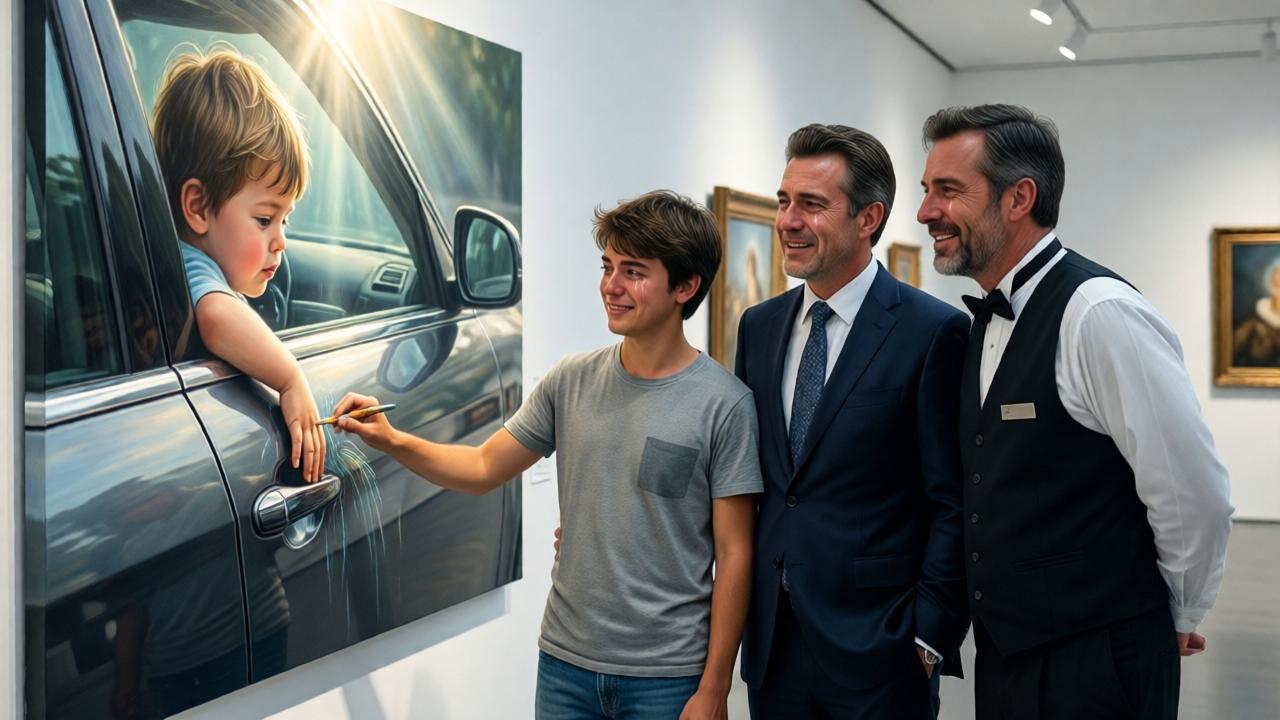
Years later, the original pencil drawing of Jesus, carefully laminated, remained on the dashboard of the Rolls-Royce, now more a family heirloom than a status symbol. Leo, a promising young artist, was preparing for his first gallery show. As he helped his son arrange the paintings, Arthur smiled. “You know,” he said, “when Marcus chased you that day, I thought it was a crisis. But it was the best thing that ever happened to me.” From the doorway, Marcus laughed. “I still maintain the kid had terrible canvas choice,” he joked, before pulling both of them into a firm, heartfelt hug. The family they had built was not a replacement for what was lost, but something entirely new, born from a moment of grace on a city street.